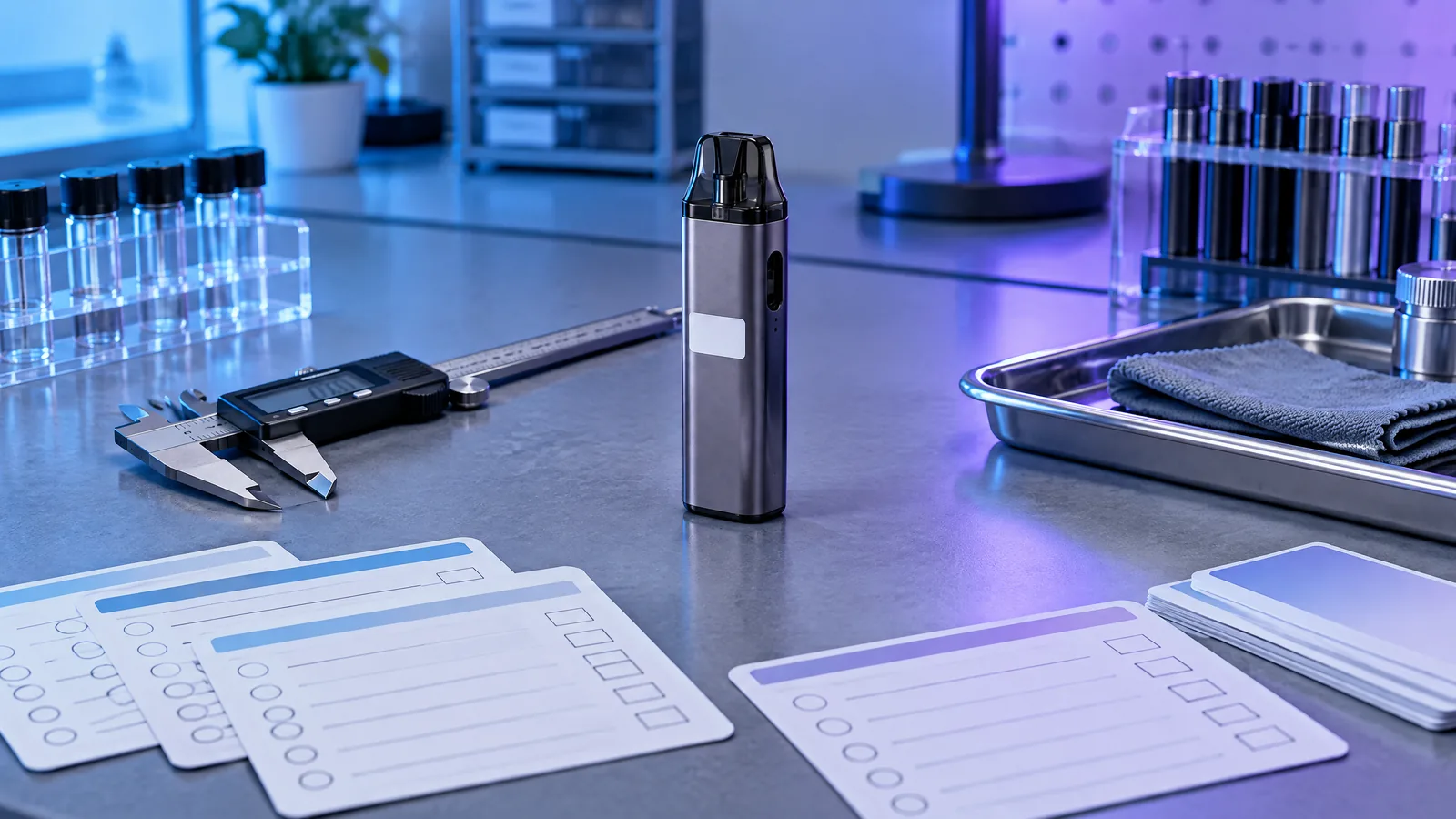
For U.S. licensed business buyers 21+, vape sample evaluation should confirm what was received, reveal gaps against a controlled specification, and direct the next revision. It should not function as blanket production approval, a regulatory conclusion, or permission to substitute materials, tooling, packaging, or process conditions later.
>
A sample is evidence, not a production release
A vapor hardware sample answers: Does this identified unit conform to the current specification? It does not prove future units will match. Later builds can differ through a drawing revision, component source, tooling, assembly method, software setting, packaging, or test setup.
Record the sample identifier, receipt date, supplier lot or build reference if provided, drawing and bill-of-materials revisions, hardware configuration, and any firmware or software identifier. Photograph the unit and packaging as received. Log unavailable information rather than assuming it.
That traceability matters because U.S. FDA oversight can extend to the manufacture, import, packaging, labeling, sale, and distribution of ENDS, including components and parts, with the agency listing examples such as cartridges, atomizers, certain batteries, tank systems, mouthpieces, and programmable software. FDA’s ENDS overview is a useful reminder that the configuration being reviewed needs a clear identity.
For an OEM, ODM, or private-label program, “sample reviewed against revision X” is materially different from “approved for all future production.” The first preserves a feedback baseline; the second can erase controls needed when the design changes.
Build the review protocol before opening the box
A disciplined vape sample evaluation begins with a one-page plan naming the sample, revision, reviewers, technical checks, equipment, and evidence to retain. It should also state what each check can support. A fit check can support a fit observation; it does not establish long-run repeatability or regulatory status.
Use the current drawing, specification sheet, artwork file, interface requirement, and test method as the comparison set. If those documents are not frozen, make the output a requirements list, not a pass decision. This often exposes an undefined surface standard, unmeasured interface, or unclear marking location.
| Review area | Question to answer | Evidence to retain |
|---|---|---|
| Identity | Which exact build is this? | Sample ID, photos, dated receipt record, revision references |
| Construction | Does the unit match the documented configuration? | Dimensional notes, materials or component declarations when provided, annotated photos |
| Interface and function | Does it operate as specified under the stated test condition? | Test method, equipment ID, test conditions, result log |
| Appearance and assembly | Does it meet the written visual and assembly criteria? | Inspection record, defect photos, disposition |
| Packaging and markings | Do the reviewed files and physical presentation align? | Artwork revision, packaging photos, marking observations |
| Change control | What must be revised, verified, or re-sampled? | Numbered issue log, owner, due evidence, closure decision |
The applicable federal regulation also illustrates why controlled detail is valuable. For premarket tobacco product applications, 21 CFR Part 1114 calls for product dimensions and construction, diagrams or schematics, materials and operating parameters, final design parameters and tolerances, plus applicable test protocols and result summaries. A buyer’s internal review file is not a regulatory submission, but this level of specificity is a useful model for preventing ambiguity. See the current regulation.
Inspect the hardware against defined acceptance criteria
Review hardware in a consistent sequence: incoming condition and identity; construction and dimensions; interfaces, assembly, controls, and indicators; then applicable connection features, packaging, and markings. Use defined lighting, tools, fixtures, and test conditions where they affect the result. Record the condition, not only the conclusion, so another reviewer can repeat the assessment.
Acceptance criteria should be measurable whenever practical. “Looks premium” is not a criterion. “No visible burrs under the specified inspection condition” is closer, if that condition is documented. Apply the same principle to alignment, gaps, engagement, seating force, label placement, and finish. Where a requirement cannot yet be quantified, assign an owner to convert it into a controlled criterion.
Separate findings into three categories. A conformance meets a named criterion in the stated test. An observation is worth monitoring but is not yet a failure. A nonconformance mismatches a documented requirement. This avoids the unhelpful binary of “looks good” or “rejected.”
Use the inspection framework in Autosweave Labs’ quality resources alongside the vapor hardware sample evaluation checklist. The goal is not to create paperwork for its own sake. It is to preserve the evidence that explains why a finding was made and what must happen next.
Convert feedback into controlled changes
A sample review becomes commercially useful when feedback becomes a controlled revision. Avoid vague approvals such as “please proceed” or “make it like the sample.” They do not identify the baseline, allowed variation, or required evidence.
Use this closeout checklist:
- Assign a unique issue number to each observation or nonconformance, with supporting photo or measurement where useful.
- State the requirement and result together. If no requirement existed, create one instead of retroactively declaring failure.
- Specify the disposition: accept for a defined development purpose, revise, obtain evidence, or request another sample.
- Update controlled documents—such as drawings, BOMs, test methods, artwork, or assembly instructions—and identify revisions.
- Verify closure against the new baseline before resolving the issue.
A change log must also distinguish a design change from a process, material, supplier, software, packaging, or marking change. Each can affect the reviewed configuration. Autosweave Labs’ change-control checklist can help keep the sample record, revision history, and follow-up evidence connected.
Keep technical acceptance separate from regulatory and import decisions
A technically acceptable sample does not establish that a product may be marketed, imported, or distributed in the United States. It does not replace the document review needed for the exact product, configuration, and commercial plan. Product-specific U.S. regulatory status and documents should be requested by verified buyers. This article is operational guidance for B2B discussions, not legal advice.
FDA’s authorized ENDS page directs readers to its searchable tobacco products database as the comprehensive listing for tobacco products that can be legally sold. Buyers should assess the status and supporting materials for their precise product rather than infer anything from an appearance, a prototype review, or a supplier statement.
Import planning requires its own workstream. U.S. Customs and Border Protection explains that the importing/exporting community shares compliance responsibility and that commodity-specific partner-government requirements may apply. Review CBP’s importing guidance with appropriate professional advisers. For a structured request, start with the supplier documentation checklist.
FAQs
Is an accepted sample final approval?
No. It is acceptance of a named sample against a stated revision and review condition. Any later change should be evaluated against the controlled baseline before the prior result is relied on.
What records should be retained after vape sample evaluation?
Retain the sample identity record, dated photos, applicable revisions, inspection and test records, issue log, correspondence that clarifies requirements, and documented closure evidence. Keep the file organized so a reviewer can see exactly what was assessed.
Can a buyer approve a design while open items remain?
A buyer can make a limited development decision, but the record should state the open items, the purpose of the decision, the restrictions, the next evidence required, and the person authorized to close each item. Do not translate a limited decision into unrestricted production acceptance.
Sources and further reading
- U.S. Food and Drug Administration: E-Cigarettes, Vapes, and Other ENDS - Electronic Code of Federal Regulations: 21 CFR Part 1114 - U.S. Food and Drug Administration: Authorized ENDS - U.S. Customs and Border Protection: Basic Importing and Exporting
Ready to define a controlled sample-review process for an OEM, ODM, or private-label hardware discussion? Request a B2B quote from Autosweave Labs.