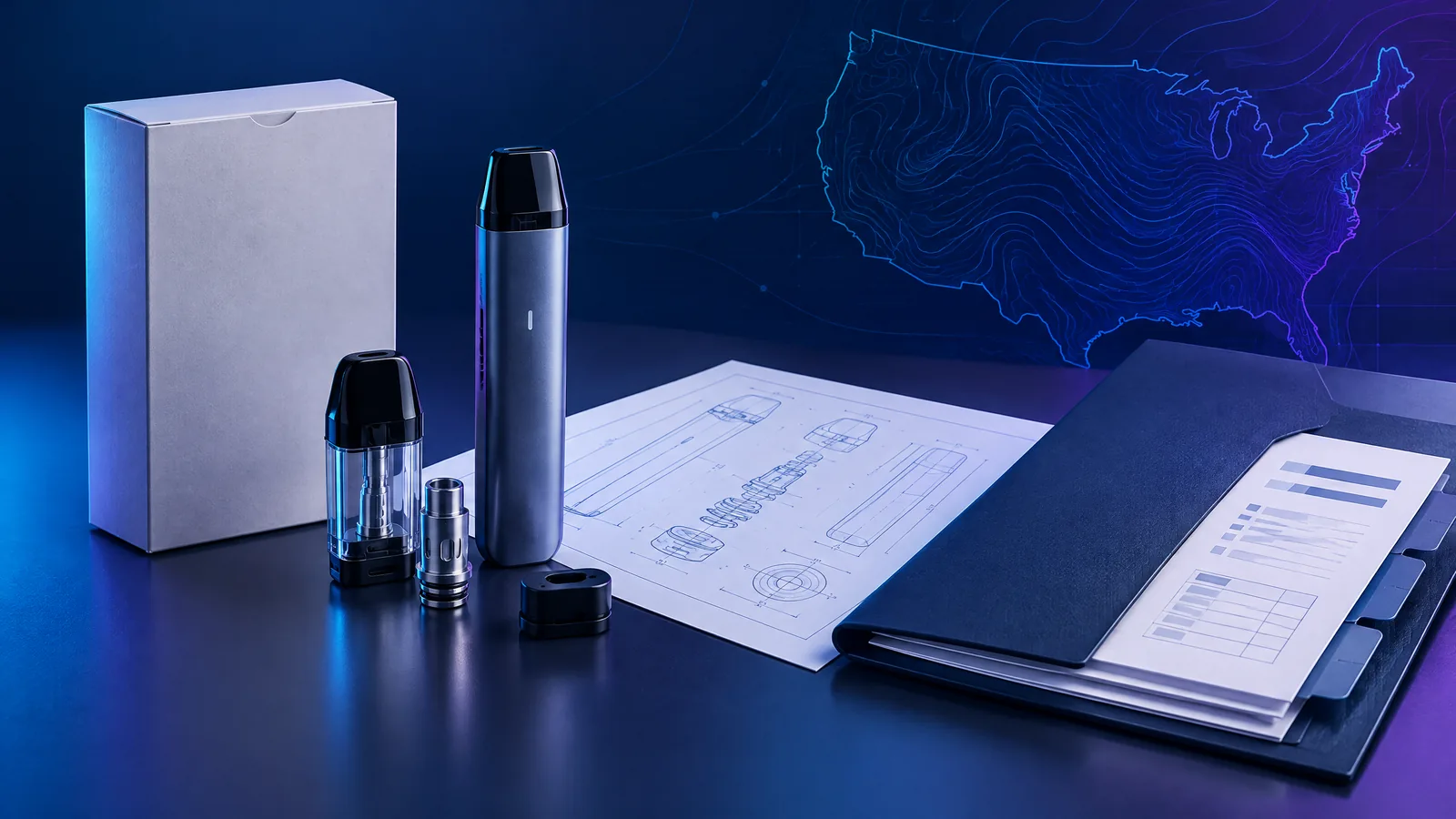
A U.S.-ready private label vapor hardware brief turns a brand idea into a reviewable product definition: the exact configuration, intended business channel, packaging direction, documentation request, test plan, and controlled approval path. It gives product, operations, and regulatory stakeholders one version of what is being evaluated before production decisions are considered.
>
Start with a decision-ready product definition
A private-label brief should open with the business decision it supports: an existing platform with branding changes, a configured OEM program, or an ODM discussion. Give the internal product name, revision date, U.S. scope, authorized reviewer, and decision gate. This prevents a technical request from becoming an unbounded design exercise.
Define the hardware at configuration level: device format, interface, power architecture, cartridge or pod relationship where applicable, materials and finish, dimensions or tolerances, control logic, charging method, and proposed pack contents. Put drawings, images, and copy decks in controlled appendices rather than email threads.
Precision matters because an apparent hardware change may be more than cosmetic. FDA regulates ENDS manufacture, import, packaging, labeling, advertising, promotion, sale, and distribution, including components and parts but excluding accessories. Its examples include cartridges, atomizers, certain batteries, tank systems, mouthpieces, digital displays, and programmable software. Review the official ENDS overview alongside the project definition.
Use a concise configuration table to establish what is fixed, what is proposed, and who must approve it.
| Brief item | Specify in the brief | Review owner |
|---|---|---|
| Core hardware | Model, drawings, materials, interface, electronics, and software version if relevant | Product lead |
| Brand and evidence | Artwork, required copy, identifiers, requested documents, and revision linkage | Brand and compliance leads |
| Review and handoff | Sample, inspection criteria, import-data path, and approval gate | Quality and operations leads |
For an overview of the distinctions that should be decided at the outset, see OEM, ODM, and private-label options. The goal is not to over-engineer a first brief. It is to make the requested configuration identifiable and reviewable.
Build the U.S. review into the brief—not after it
A U.S. market review is a structured request for information, not a compliance declaration. Under 21 CFR Part 1100, a component or part includes software or an assembly of materials intended or reasonably expected to affect a tobacco product’s performance, composition, constituents, or characteristics, or to be used with or for human consumption. Classification depends on intended and reasonably expected use.
FDA’s import guidance says tobacco products imported or offered for import must comply with applicable FDA laws and regulations. Import-time checks can include market authorization, labeling, and user fees; reviewers use data such as declared manufacturer, importer or consignee, and product description. Let FDA’s tobacco-product import guidance inform the data fields a buyer requests.
Identify the exact SKU or configuration, hardware revision, intended label and packaging revision, and expected importer or distributor. Ask which documents exist for that configuration, who issued them, when, and which model, revision, or artwork they cover. A generic presentation is not a review trail.
Verified buyers should request product-specific U.S. regulatory status and supporting documents before a commercial decision. FDA explains that new tobacco products are subject to premarket requirements and modifications can be relevant; do not infer status from a supplier relationship or product-family label. Consult qualified U.S. counsel and regulatory specialists for your facts. This article is not legal advice.
Specify documents, artwork, and claims controls
A strong brief creates a documentation matrix with an owner, version, product link, and review status. Start with the product description, identifiers, component list, drawings, artwork proofs, packaging specification, inspection plan, sample record, and change-control record. Add shipment-facing data needed to reconcile the final product and commercial documents.
Keep marketing language in a separately controlled copy section. Do not introduce health, cessation, risk-reduction, therapeutic, or comparative claims. FDA’s import guidance notes labels, labeling, and advertising may be examined, including for certain modified-risk descriptors or therapeutic positioning. Treat claims review as a release condition.
Include the artwork file name, print revision, location of required content, identifier rules if applicable, and final approver. Distinguish a packaging concept from production-approved artwork. Organize requested evidence so the review record stays linked to its configuration.
Make sampling and quality review traceable
A sample is useful only when the team can state what it represents. Assign a sample ID; map it to the configuration and revision; list deviations; document receipt; and record disposition. Photographs and measurements should point to the same sample ID.
The evaluation plan can cover workmanship, assembly consistency, fit or interface checks, relevant function checks, packaging, markings, and documentation reconciliation. Define the method and evidence before review. Record any condition outside the agreed configuration as a deviation.
Use the vapor hardware sample evaluation checklist for review records and the vapor hardware quality inspection checklist for inspection planning. Neither replaces a product-specific regulatory assessment.
Control changes across the private-label lifecycle
Private-label projects evolve through artwork updates, supplier substitutions, component adjustments, firmware revisions, packaging edits, or logistics changes. Define which changes require notice, a new sample or document review, and approval. Every released version should connect to a known hardware, artwork, document, and approval record.
Use a numbered change workflow:
- Log the product identifier, current revision, reason, and requested effective point.
- Identify affected drawings, component lists, software, artwork, samples, inspection criteria, and import descriptions.
- Determine whether a new sample, document request, or U.S. review is needed.
- Capture disposition, approval date, approver, and released revision in one controlled record.
- Reconcile purchase and shipment data against the released revision.
FDA explains that a modification can include changes in design, a component, a part, a constituent, or nicotine content, delivery, or form. Do not treat an updated product as automatically equivalent to a prior version. Use the change-control checklist to make responsibilities explicit.
CBP emphasizes that importers and exporters share responsibility for compliance and that commodities may have partner-government-agency requirements. See CBP’s basic importing guidance when assigning operational owners. Coordinate with a customs broker and qualified advisers before cargo planning.
FAQs
What is the minimum useful private-label hardware brief?
Include a controlled product configuration, brand and packaging scope, U.S. review scope, documentation request, sample criteria, approvers, and change-control path. “Add our logo” is not enough for a review.
Should the brief say that the product is authorized for the U.S. market?
No. Request current, product-specific U.S. regulatory status and documents from verified buyers, then route them for appropriate review. Do not make a status conclusion from a family name, sample, or supplier statement.
Who should approve a revised configuration?
Assign product, brand, quality, operations, and compliance reviewers according to the change. Name a final release owner and show which documents and samples were reviewed for that revision.
What should be included in an initial supplier request?
Share the configuration, requested evidence, artwork status, sample needs, inspection expectations, and buyer decision timeline without treating it as a production commitment. A structured request-a-quote conversation can begin once verified parties align the inputs.
Sources and further reading
- FDA: E-Cigarettes, Vapes, and Other Electronic Nicotine Delivery Systems - FDA: Importing Tobacco Products - eCFR: 21 CFR Part 1100—General - U.S. Customs and Border Protection: Basic Importing and Exporting
For a controlled private-label vapor hardware discussion, verified business buyers can request a quote with their configuration, documentation, and review requirements.