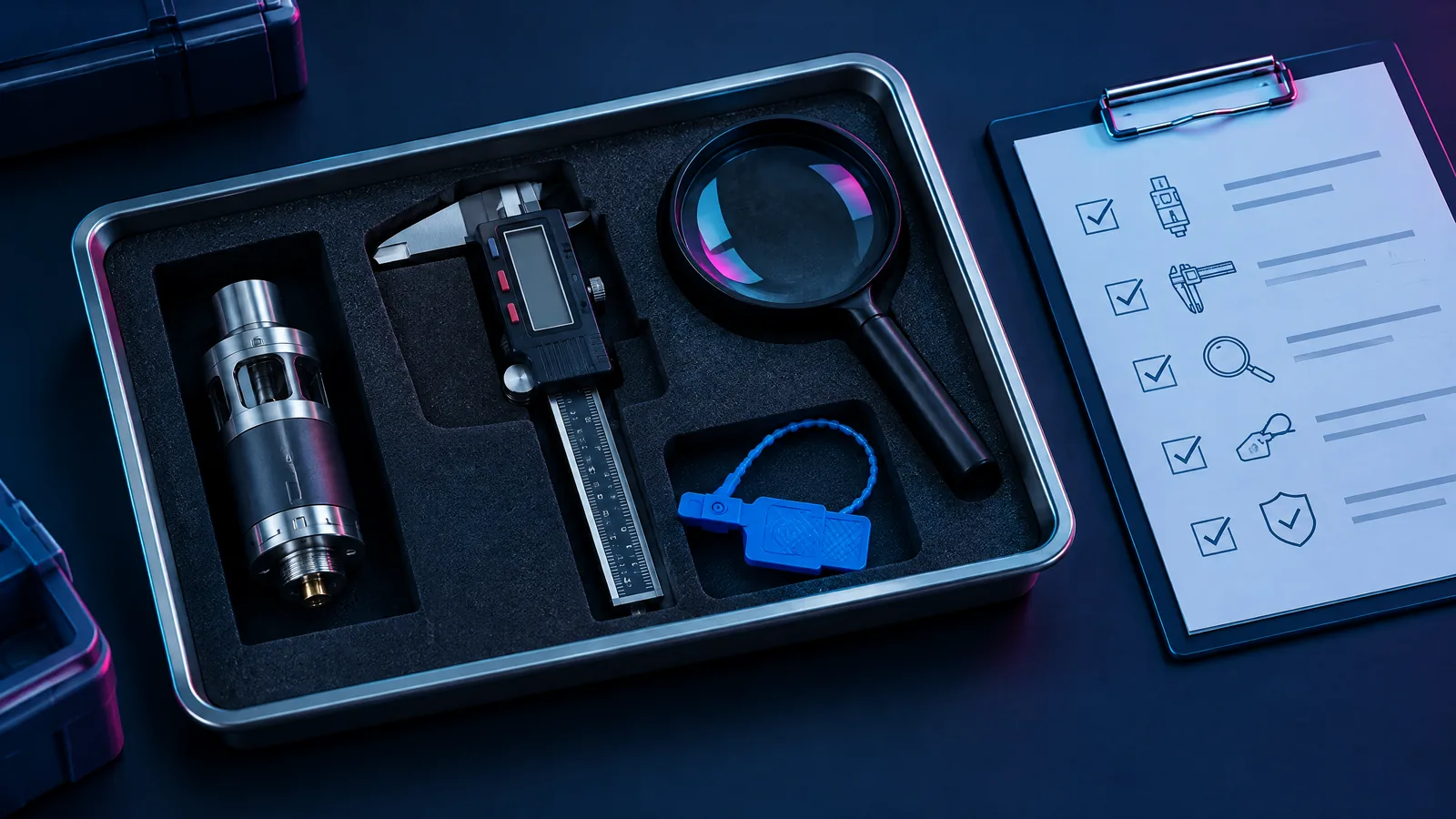
A pre-shipment vapor-hardware inspection should produce decision-ready evidence—not a generic “passed” message. For licensed U.S. business buyers aged 21+, this vape quality inspection checklist turns the approved specification, sample, packaging files, and order records into traceable photos, counts, measurements, and disposition notes before release.
Start with an inspection plan that can be audited
The strongest inspection begins before cartons are opened. Freeze the version-controlled inputs: the purchase order, bill of materials where applicable, approved drawing or artwork, golden sample, packaging specification, labeling copy, and any agreed acceptance criteria. Assign a unique inspection record ID that connects the inspection date, production or lot reference, order line, and destination.
This matters because a cosmetic or functional observation only has meaning when the checker can identify what it was compared against. “Thread feels rough,” for example, is less useful than “10 of 32 sampled units did not smoothly mate with the approved reference after cleaning; photos and unit IDs attached.” Use plain evidence language that a procurement, quality, and logistics reviewer can independently understand.
For OEM, ODM, or private-label programs, control the exact configuration—finish, markings, interface, accessories, packaging dieline, and carton marking. A last-minute change can affect acceptance and documentation. Build that control into OEM/ODM and private-label planning.
Set the sampling method and escalation rule before inspection. The plan may call for a defined sample size, a 100% check of certain critical characteristics, or a targeted expansion when defects are found. The key is consistency: record what was sampled, why, and what would trigger a hold. Do not imply that a sample result proves every unit conforms.
Use the buyer evidence checklist before shipment release
The checklist below is a practical framework for a hardware-only B2B release review. Adapt the characteristics, tolerances, and test methods to the written product specification; a generic list cannot replace those approved requirements.
| Checkpoint | Evidence to capture | Release question |
|---|---|---|
| Identity and quantity | PO number, SKU, lot or batch identifier, carton count, unit-count reconciliation, carton photos | Does the inspected stock match the order and declared quantity? |
| Build and finish | Dated photos of sampled units, color/finish comparison, assembly observations, defect count by type | Does the sampled hardware match the approved appearance and construction standard? |
| Interfaces and fit | Measurement readings where required, connector/fit test record, compatible reference fixture or approved mating part | Do specified interfaces assemble and function as documented? |
| Basic function | Test method, test equipment or fixture ID, units tested, pass/fail result, observed exceptions | Did the defined functional checks produce the specified result? |
| Packaging and traceability | Unit-pack, inner-pack, master-carton photos; label/artwork version; carton marks; lot traceability | Are the approved packaging files and identifiers used consistently? |
| Disposition | Defect log, deviation authorization if any, rework evidence, inspector and buyer decision | Is there a documented basis to release, conditionally release, rework, or hold? |
Photograph the shipment before and after selected cartons are opened. For observed defects, include a scale or reference when useful. Preserve the inspection ID in file names. If video supports a dynamic test, log the unit ID, sequence, and pass/fail outcome; video without context is hard to audit.
A credible report reconciles cartons presented, cartons selected, units sampled, units passed, units failed, and units segregated. If the count cannot be reconciled, treat it as an open release issue.
Test the interfaces and functions that matter to the order
Inspect characteristics that could change product identity, assembly, or buyer acceptance. For threaded or press-fit hardware, test mating behavior with the approved counterpart. For powered hardware, use only the agreed operational checks and repeatable setup. Do not substitute a casual handling demonstration for the defined test.
Write the method before the result. Identify the fixture, reference component, sequence, and observation criteria. Report number tested, number passing, defect type, and whether the finding repeated. Measurements should show the instrument ID and units; a photo supports, but does not replace, the log.
Use a defect taxonomy that keeps decisions consistent. Critical findings are those the buyer’s specification defines as a hold. Major findings affect assembly, function, traceability, or agreed appearance. Minor findings still require count-based visibility. These are commercial quality controls, not regulatory classifications; define treatment for repeat findings before inspection.
When an observation falls outside the approved criteria, preserve the unit or carton reference, photograph it, and avoid unapproved correction. Ask for a documented disposition: rework, replacement, acceptance under a written deviation, or hold. The buyer should be able to see what changed and why. For a broader sequence from sample approval through release, pair this step with a vapor-hardware sample evaluation checklist.
Verify packaging, marks, and shipment readiness
Packaging inspection is not just a damage check. Compare the unit pack, inserts, inner packs, master cartons, tamper features if specified, and carton marks against the approved artwork and packing specification. Record the artwork or revision identifier actually observed. Check that location-specific details such as SKU, quantity, and lot reference are present where the specification requires them.
Separate freight-risk issues from product defects. Photograph carton condition, sealing method, palletization if applicable, and visible compression, moisture exposure, or mixed-label risk. Record dimensions and gross weight only when required. This gives logistics teams a factual handoff rather than an unsupported “shipping-ready” statement.
Ask for commercial and transport documents that match the inspected shipment, such as the packing list, commercial invoice, and agreed shipping or battery records. Check that product description, quantities, consignee details, and lot identifiers do not contradict the inspection record. Coordinate handoff through the shipping and logistics process before cargo is tendered.
Treat U.S. regulatory documents as a separate buyer verification gate
Physical quality evidence does not establish U.S. regulatory status. FDA states that tobacco products imported or offered for import must comply with applicable FDA requirements; its import guidance identifies market authorization, labeling, and user fees among items reviewed at import (FDA: Importing Tobacco Products). FDA also says inaccurate or incomplete entry information may delay review.
For products within the applicable tobacco-product framework, FDA explains that a PMTA may be submitted for a new tobacco product seeking a marketing order and publishes searchable marketing-granted orders (FDA: Premarket Tobacco Product Applications). A generic inspection report is not evidence of a product’s marketing status.
Accordingly, product-specific U.S. regulatory status and documents should be requested by verified buyers; this is not legal advice. Make that a release-gate question with an assigned owner, not a verbal assurance. Retain the document request, source, version, and decision trail with the supplier documentation checklist; seek qualified regulatory counsel where needed.
CBP has also reported ENDS enforcement actions involving products lacking required FDA marketing authorization and, in some cases, intellectual-property violations (CBP: ENDS seizure notice). That is a reason to verify product identity and documentary consistency before cargo moves—not a substitute for product-specific legal review.
Frequently Asked Questions
Who should sign a pre-shipment inspection report?
The inspector should identify the report author and date it. The buyer should record the release decision separately, particularly for a documented deviation.
Can photos alone support a shipment release?
No. Photos need item identity, sampling details, test results, and an acceptance criterion. They do not replace quantity reconciliation or agreed functional checks.
What happens if the sample reveals a defect?
Pause release, record the unit or carton reference, and apply the escalation rule. The buyer can request expanded inspection, segregation, rework evidence, replacement, or a written deviation.
Does a quality inspection confirm U.S. compliance?
No. A quality inspection records physical and documentary checks defined by the buyer. Product-specific U.S. regulatory status and supporting documents require a separate verified-buyer review. This article is not legal advice.
Sources and further reading
- FDA — Importing Tobacco Products - FDA — Premarket Tobacco Product Applications - U.S. Customs and Border Protection — ENDS seizure notice
Next step: For a documented, configuration-specific B2B inspection scope, request a quote from Autosweave Labs.