Pod System vs. Cartridge vs. All-in-One Vapor Hardware: A B2B Buyer Guide
Pod systems, cartridges, and all-in-one vapor hardware are different project starting points—not interchangeable specifications. A licensed B2B buyer should compare the exact configuration, power-and-delivery interface, intended market, documentation route, packaging scope, and project changes before deciding which form factor to evaluate. The category label alone does not confirm a model’s technical specification, U.S. marketing status, availability, or commercial terms.
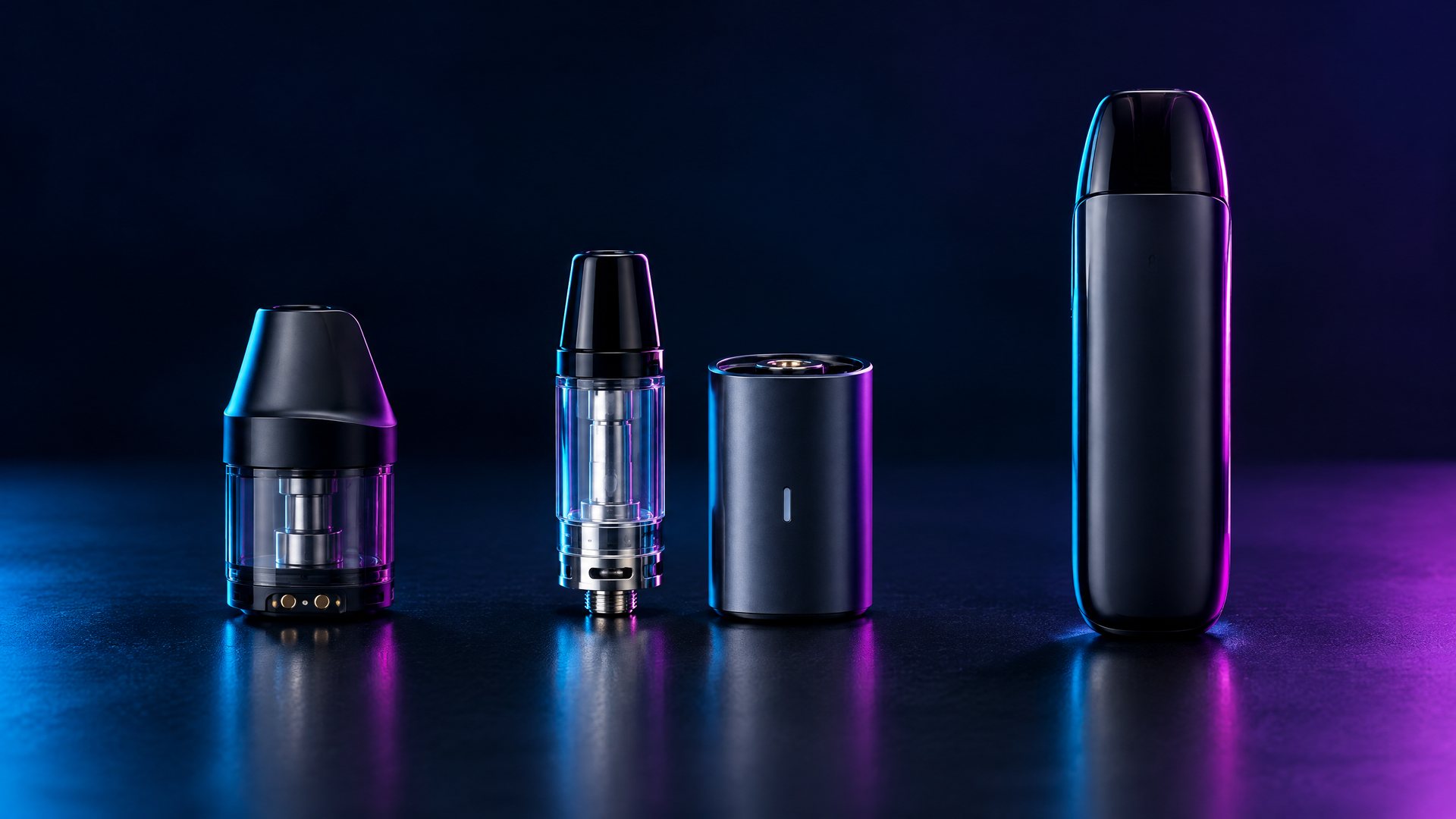
What is the difference between pod systems, cartridges, and all-in-one vapor hardware?
The practical difference is how the buyer frames the power and delivery hardware for the proposed project. For this guide, a pod system is a configuration in which a pod-style delivery module and a compatible power unit are reviewed as an intended system. A cartridge configuration is a project in which a replaceable cartridge and a separate compatible battery or interface are defined separately. An all-in-one configuration is reviewed as one assembled device with the relevant power and delivery elements considered together.
These are planning definitions, not universal product specifications. FDA identifies cartridges, atomizers, certain batteries, tank systems, mouthpieces, digital displays or lights used to adjust settings, and programmable software among the components and parts of ENDS that it regulates; FDA also explains that ENDS can have reusable parts or be disposable.1 For a buyer, that means a category label should never substitute for an exact project brief.
Use the product reference gallery to identify a hardware conversation, then use the OEM / ODM / private-label process to choose the appropriate commercial route. The gallery is a starting reference only; model-specific requirements must be verified.
Which vapor hardware form factor should a B2B buyer compare first?
Start with the form factor that best matches the buyer’s project definition and decision path—not the most familiar market term. The comparison below helps a licensed buyer organize questions. It does not establish product performance, compatibility, availability, market authorization, MOQ, lead time, or final commercial scope.
| Form factor | Buyer planning question | What to define before a B2B review |
|---|---|---|
| Pod system | Is the project centered on a defined pod module and an intended compatible power unit? | State the exact pod form, power interface, charging context, allowed configuration, packaging question, intended market, and evidence request. |
| Cartridge configuration | Is the project centered on a replaceable cartridge and a separately defined battery or interface? | State the cartridge type, interface or connection question, intended power context, component scope, packaging, destination, and document needs. |
| All-in-one hardware | Is the project intended to be reviewed as one assembled power-and-delivery configuration? | State the exact assembled configuration, charging or battery context, relevant presentation scope, intended market, requested records, and decision owner. |
A buyer should keep two comparison questions separate. First, which architecture best matches the planned commercial program? Second, which exact configuration, components, documents, and destination conditions will be reviewed? The second question prevents a form-factor name from becoming an unsupported claim about a particular item.
How should a buyer compare the power, delivery, and interface scope?
Treat the form factor as an interface and system-scoping question before treating it as a design preference. The buyer should record which delivery component is under discussion, what power source or interface is intended, whether any settings or controls are in scope, and which accessory or charger context requires review. A supplier can then route the correct technical, quality, and commercial questions for that project.
CPSC staff recommends a system approach for battery-powered products: thermal protection, charge and discharge protection, and intended use should be considered together. It further recommends that cells, batteries, chargers, and the end product be tested together for safe function and appropriate conditions.2 This is general battery-system context, not a statement that any particular pod, cartridge, or all-in-one configuration is tested, certified, safe, or approved.
For the buyer’s project record, separate the following items:
- Delivery configuration. Identify the stated pod, cartridge, tank, or other delivery component that is under review.
- Power and charging context. Identify the battery-powered configuration, intended use, charger or charging conditions, and the evidence that may be requested.
- Interface question. State any connection, compatibility, control, or assembly question without assuming equivalence across models.
- Presentation scope. Keep branding, packaging, labeling, and artwork questions separate from the hardware architecture.
- Decision boundary. Record what the comparison can inform and what still requires technical, commercial, documentation, or product-specific regulatory review.
The sample evaluation checklist is useful when a buyer needs to document an early review of a proposed configuration. The quality inspection checklist is the appropriate next resource when the question becomes a defined production lot and pre-shipment baseline.
What documentation should accompany a pod, cartridge, or all-in-one comparison?
Ask for a document pathway tied to the exact project rather than a generic bundle attached to a category name. A meaningful request separates technical details, quality and change-control information, commercial information, logistics context, and product-specific U.S. status questions. This makes it clear which records may be relevant, which are missing, and which must be handled through the verified-buyer process.
| Documentation area | Example buyer question | Why it should stay project-specific |
|---|---|---|
| Configuration description | Which stated power unit, delivery component, interface, and packaging scope are under discussion? | A general category page cannot prove the configuration of a sample, lot, or proposed transaction. |
| Quality and inspection | What evidence, inspection scope, deviation record, or release condition is relevant? | Evidence should map to the exact lot, project baseline, and decision it is intended to inform. |
| Change control | What happens if a component, interface, packaging, supplier, or process changes? | A change can alter the project baseline and needs a defined notification or review route. |
| Commercial and logistics | What are the verified commercial route, destination, timing, and importer questions? | MOQ, lead time, trade terms, and destination eligibility are transaction-specific. |
| U.S. regulatory status | How is product-specific status provided to verified buyers? | Form factor does not determine a specific product’s U.S. marketing status. |
For a structured request, use the vape supplier documentation checklist. If the project changes after the buyer has evaluated a preferred configuration, use the vapor hardware change-control checklist to record the baseline, proposed change, evidence route, and decision condition.
Does a hardware form factor decide U.S. regulatory status?
No. A pod, cartridge, or all-in-one label does not decide whether a particular product can be legally marketed in the United States. FDA states that a company must receive a written marketing order to legally market a new tobacco product in the U.S.3 Product-specific status should therefore be requested and evaluated for the exact configuration, intended market, and transaction.
FDA also notes that it regulates the manufacture, import, packaging, labeling, advertising, promotion, sale, and distribution of ENDS, including components and parts of ENDS but excluding accessories.1 This general context does not determine how any requirement applies to an individual product, company, or buyer. The Compliance Center provides general site context; qualified legal and regulatory advice is required for a specific product or transaction.
What should a buyer avoid when comparing pod systems, cartridges, and all-in-one hardware?
Avoid using a general architecture label as proof of equivalence, compatibility, safety, regulatory status, shipment eligibility, or commercial availability. A buyer should not infer that one sample represents every future lot, that one accessory applies to every configuration, or that a prior project’s record covers a changed component, destination, or packaging scope.
Keep the project brief specific. Do not submit sensitive licenses, resale records, proprietary artwork, or confidential documents through a public inquiry form. Instead, describe the needed document categories and request an approved verified-buyer route for sensitive material.
How should a B2B buyer turn a form-factor comparison into an RFQ?
An effective RFQ turns a broad “pod vs. cartridge vs. all-in-one” question into a decision-ready project brief. It lets the supplier identify what must be confirmed rather than guessing from a consumer category label.
- Name the candidate architecture. Identify whether the discussion concerns a pod system, cartridge configuration, all-in-one hardware, or more than one comparison path.
- Define the hardware scope. Describe the stated delivery component, power or interface question, requested configuration, and any approved customization or packaging question.
- State the commercial context. Share the intended market, purchase range, decision timing, destination, and authorized business contact.
- List evidence and document needs. Separate technical, quality, change-control, logistics, and product-specific regulatory-status requests.
- Record open items. Do not treat unanswered configuration, documentation, logistics, or status questions as approvals.
Use the MOQ and manufacturing RFQ guide to structure the commercial inputs, then submit an RFQ with the exact project scope. Autosweave Labs serves licensed adult B2B buyers only.
Sources and further reading
- U.S. Food and Drug Administration, “E-Cigarettes, Vapes, and Other Electronic Nicotine Delivery Systems (ENDS)” — accessed October 2, 2026.
- U.S. Consumer Product Safety Commission, “Batteries” — accessed October 2, 2026.
- U.S. Food and Drug Administration, “Tobacco Products Marketing Orders” — accessed October 2, 2026.
Frequently Asked Questions
What is the difference between a pod system and a cartridge configuration?
For a B2B project, a pod-system comparison centers on a defined pod module and intended compatible power unit. A cartridge comparison centers on a replaceable cartridge and separately defined battery or interface. The exact configuration, component scope, documentation, and intended market must still be verified for the project.
Is an all-in-one vapor device always a disposable device?
No universal conclusion should be drawn from the label alone. This guide uses “all-in-one” to describe a buyer’s project scope: an assembled power-and-delivery configuration reviewed together. The exact device construction, reuse status, components, and market context must be confirmed for the model under discussion.
Do pod systems, cartridges, and all-in-one hardware have the same U.S. regulatory status?
No. A form-factor label does not establish the U.S. marketing status of a specific tobacco product. FDA states that a written marketing order is required to legally market a new tobacco product in the United States. Request product-specific status information through a verified-buyer process and seek qualified advice where appropriate.
What should a buyer compare before requesting a vapor hardware quote?
Identify the candidate form factor, exact delivery component, power or interface context, intended market, requested documentation, expected purchasing range, destination, timing, and the authorized business contact. Keep open technical, logistics, and product-status questions visible until they are verified.
Next step for licensed B2B buyers
To begin a qualified form-factor discussion, submit an RFQ with the candidate architecture, project baseline, power-and-delivery scope, intended market, documentation request, destination, and decision timing. The RFQ route is for licensed adult B2B buyers only.