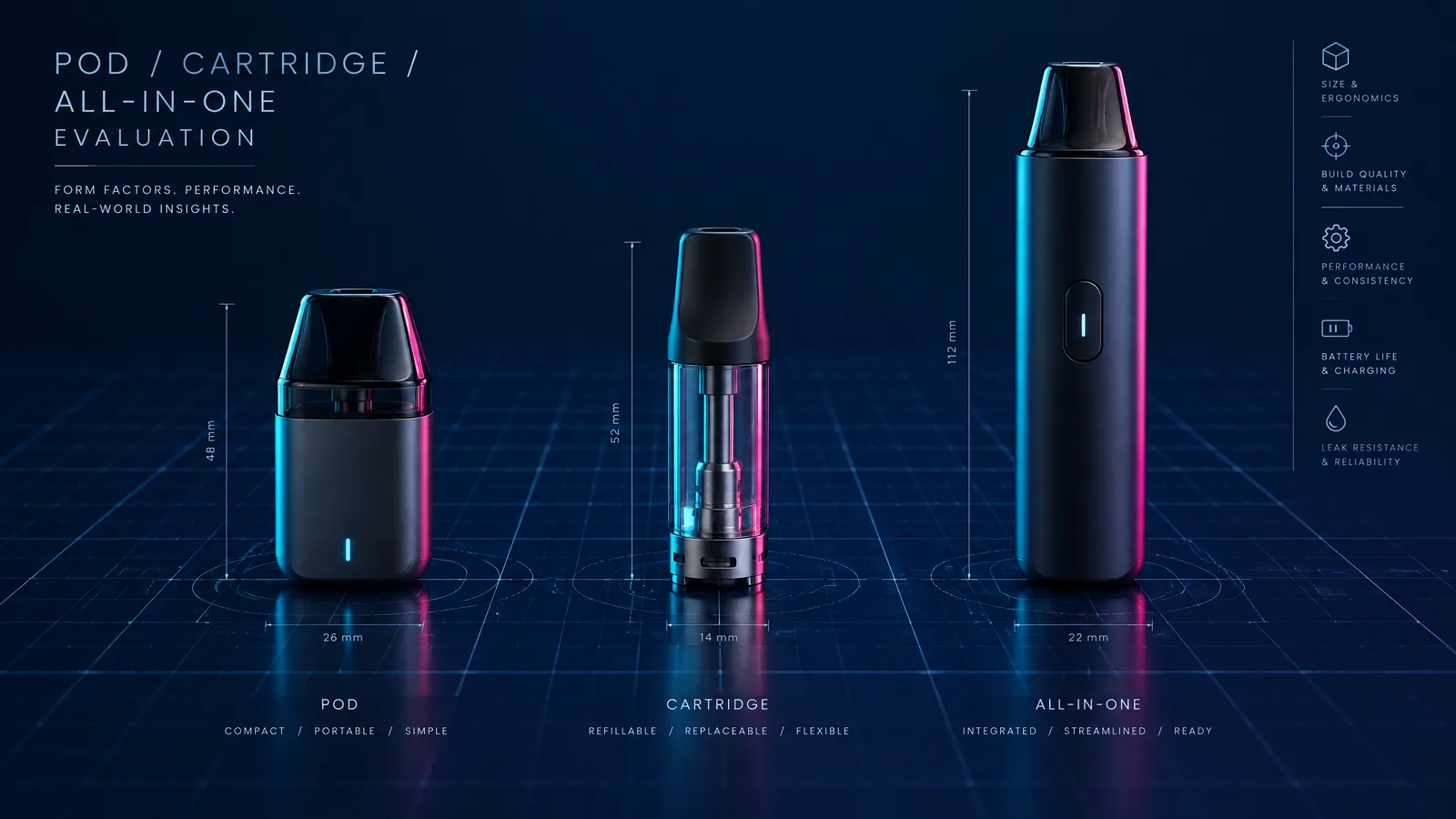
For a licensed U.S. business buyer, the right platform is the one whose configuration, documentation, and change controls match the intended program—not simply the smallest device or the most integrated one. Evaluate pod systems, cartridges, and all-in-ones as distinct supply-and-compliance paths, then test the exact configuration you intend to discuss.
>
Start with the regulated configuration, not the category name
“Pod,” “cartridge,” and “all-in-one” are commercial shorthand, not controlled product definitions. Document the exact hardware under review: housing, power source, charging method, contacts, reservoir or cartridge geometry, atomization assembly, materials, markings, packaging, and relevant software or settings. Use the candidate configuration in the Autosweave Labs product discussion as a starting point, then attach a revision identifier to the evaluation record.
This discipline matters in the United States. FDA regulates ENDS manufacture, import, packaging, labeling, sale, and distribution, including components and parts but excluding accessories. Its examples include cartridges, certain batteries, tank systems, mouthpieces, and programmable software. FDA’s ENDS overview says that parties that make, modify, manufacture, assemble, label, repack, relabel, or import ENDS must comply with manufacturer requirements.
That is why a pod system manufacturer conversation should not stop at photographs or a generic device name. The relevant question is: what exact configuration, responsibilities, and controlled changes are being evaluated? Product-specific U.S. regulatory status and documents should be requested by verified buyers before a commercial decision. This is not legal advice; buyers should obtain advice appropriate to their own role and planned activity.
Compare the evaluation paths before requesting samples
The form factor should drive the questions you ask, the samples you retain, and the evidence you expect to see. It should not be used as a shortcut for regulatory conclusions.
| Evaluation path | What the review primarily isolates | Core questions for the specification | Sample-evaluation gate |
|---|---|---|---|
| Pod system | The removable pod-to-power-unit interface | How are pod revision, contacts, latch, charging behavior, and power-unit settings controlled together? | Confirm the exact pod and power-unit pairing across the agreed evaluation set. |
| Cartridge | The reservoir-and-connection assembly | What are the connection geometry, electrical envelope, sealing features, and compatible host configuration? | Test the named cartridge against the named host configuration; do not infer compatibility from fit alone. |
| All-in-one | A single integrated hardware configuration | How do the cell, charge circuit, controls, reservoir, and enclosure interact within one revision? | Review the complete finished configuration, its packaging, and its transport-related records together. |
For an OEM, ODM, or private-label project, turn the selected row into a requirements sheet. Identify which features are fixed, which ones may vary, and who may approve a revision. The OEM/ODM and private-label overview is useful for aligning those commercial roles before the technical review begins.
Evaluate pod, cartridge, and all-in-one hardware on their own terms
Pod systems: control the interface as a system
A pod system separates a power unit from a replaceable pod. Its modularity creates an interface that must be managed. Review mechanical engagement, contact alignment, polarity safeguards, behavior within the specified pairing, and the conditions that define a fully seated pod. Request clear revision identification for the pod and power unit.
Pair multiple pods with multiple power units from the agreed evaluation set. Inspect for intermittent contact, seal integrity at the device interface, and differences caused by a revised pod or power unit. Retain tested pairings, observations, and photographs. A structured sample evaluation checklist keeps commercial and technical teams on the same configuration.
Cartridges: prove the named connection, not a presumed ecosystem
A cartridge review centers on the reservoir-and-connection assembly. State the connection type and dimensions, nominal electrical conditions, contact locations, sealing architecture, closure geometry, and the host configuration used for review. A cartridge that appears to fit another device may still behave differently because of contact travel, control logic, power behavior, or tolerance accumulation.
Evaluate integrity in the stated orientation and packaging position. Check assembly, seal placement, contact condition, and traceable cartridge revision. If the connection or host device changes, open a new evaluation record. Compatibility should be a documented result of the tested combination, not an assumption based on a shared profile.
All-in-one hardware: evaluate one integrated configuration
All-in-one hardware combines functions that may otherwise be assessed separately. Tie the enclosure, cell or battery pack, charging connection, controls, reservoir or cartridge arrangement, atomization assembly, and markings to one revision.
Battery-containing hardware needs a specific evidence request. PHMSA says lithium cells and batteries offered for transportation must have passed the applicable UN Manual of Tests and Criteria, Section 38.3 design tests; manufacturers must make test summaries available upon request. See PHMSA’s lithium-battery transportation guidance. Confirm that supplied records correspond to the battery design in the exact sample configuration.
CPSC advises a system approach: cells, packs, chargers, and end products should be tested together for safe function and appropriate conditions. Its battery safety resource identifies overheating, fire, electrical shock, and thermal burns as potential battery and charger hazards. Review the charging setup and finished hardware together rather than a cell in isolation.
Build a buyer-controlled evaluation record
Whichever path you choose, close the review with a shared record rather than a verbal sign-off. A concise, buyer-controlled checklist can include:
- Configuration identity: Record model designation, revision, sample identifiers, pairing rules, and dated photographs.
- Bill-of-materials scope: List the materials and functional parts that define the evaluated configuration; flag any item that may change.
- Functional observations: Record the agreed checks for interface seating, seals, contacts, charging, controls, and packaging condition.
- Document review: Request product-specific U.S. regulatory status and supporting documents from the responsible party, with dates and configuration references. Do not treat generic files as evidence for a different revision.
- Transport review: For battery-containing hardware, request the applicable transport documentation for the battery design and compare it with the sample record.
- Change control: State who must approve a change to a material, dimension, battery design, electrical setting, enclosure, marking, or packaging element.
The final item protects the work already invested in sampling. Use a written hardware change-control checklist to distinguish a replacement component from a configuration change that requires renewed review. For broader documentation questions, verified buyers can also consult Autosweave Labs’ compliance information.
FAQs
Does the form factor determine U.S. regulatory status?
No. A category name does not determine the obligations associated with a specific product or business role. FDA’s ENDS materials address components and parts as well as finished products. Verified buyers should request product-specific U.S. regulatory status and documents for the exact configuration and seek appropriate legal guidance.
What should verified buyers request before moving beyond evaluation?
Request a configuration-specific product description, revision-controlled drawings or specifications, parts or materials scope, sample identifiers, packaging information, and a documented change-control process. For battery-containing hardware, request applicable transport records tied to the battery design.
Can a cartridge be treated as compatible because it physically connects?
No. Physical connection is only one observation. Evaluate the exact host configuration for mechanical engagement, contact alignment, electrical behavior, sealing, and controlled revision identity. Record the tested pairing and treat a host-device change as a new evaluation question.
When should an all-in-one be re-evaluated?
Re-evaluate when a change affects the controlled configuration or its supporting evidence. Define change triggers before sign-off for battery design, charging arrangement, enclosure, electrical control, reservoir assembly, material, marking, and packaging.
Sources and further reading
- U.S. Food and Drug Administration: E-Cigarettes, Vapes, and Other Electronic Nicotine Delivery Systems - U.S. Food and Drug Administration: Tobacco Products, Ingredients & Components - U.S. Department of Transportation, PHMSA: Transporting Lithium Batteries - U.S. Consumer Product Safety Commission: Batteries
Ready to structure an evaluation around your specified hardware configuration? Verified business buyers can request a B2B quote with the proposed pod, cartridge, or all-in-one configuration and the documentation questions they need addressed.